

Lilith didn’t sin. She wasn’t even there when sin happened. That single structural fact changes everything the tradition has told you about her — and about Mary.
There is a gap in the Eden story that almost no one talks about. Not because it is hidden — it is sitting right there in the sequence of events — but because the tradition that controls the story needed you to not notice it.
Here is the gap: Lilith left before the serpent arrived.
The sequence, read carefully, runs like this: Adam and Lilith are created. They dispute. Lilith invokes the divine name and departs. God creates Eve from Adam’s rib. The serpent arrives. Eve eats. Adam eats. The Fall occurs.
Lilith is gone before any of this happens. She is at the Red Sea, having made her own terms with the three angels, when the serpent is making its case to Eve.
What Original Sin Actually Claims
The doctrine of Original Sin — in its Augustinian form, which is the form that shaped Western Christianity — is a claim about a specific event and its transmitted consequences. Adam and Eve transgress. A corruption enters human nature. That corruption is inherited by every subsequent human through biological descent.
This is not a generalised claim about human moral failure. It is a claim about a specific mechanism: the transmission of a specific damage introduced at a specific moment.
Lilith is not present at that moment. She has no biological connection to its consequences. She left before the transmission mechanism was set in motion.
In the tradition’s own internal logic — not in any external framework imported from outside — she is the only human being who was never subject to what the Fall introduced.
The Tradition Had No Category for This
Here is where it gets interesting. The tradition operates with two categories: the fallen (everyone descended from Adam and Eve, in need of redemption) and the redeemed (those brought back through Christ’s atoning work).
Lilith fits neither. She is not fallen in the Augustinian sense because she was never present for the Fall. She is not redeemed in the Christian sense because redemption presupposes a fall from which one requires rescue — and she never had one.
The tradition had no theological language for a human soul that was uncorrupted but aware. A soul that exercised genuine moral agency before the category of sin was established. A soul that departed carrying the only uncorrupted version of the original human nature.
So it called her a demon.
The Inconvenient Mathematics
The mathematics of this are not subtle. The Church spent centuries building the doctrine of the Immaculate Conception — a unique divine exception preserving Mary from Original Sin — precisely because no naturally born human could be sinless, and the Incarnation required a sinless vessel.
But Lilith’s soul never needed that exception. It was never in the condition the exception was meant to remove.
The tradition invented a doctrine to fill a gap it created by suppressing the figure whose soul would have filled it naturally.
In my experience, the moment this structure becomes visible, it doesn’t let go. The gap is too clean. The mathematics fit too precisely to be coincidental.
What This Means
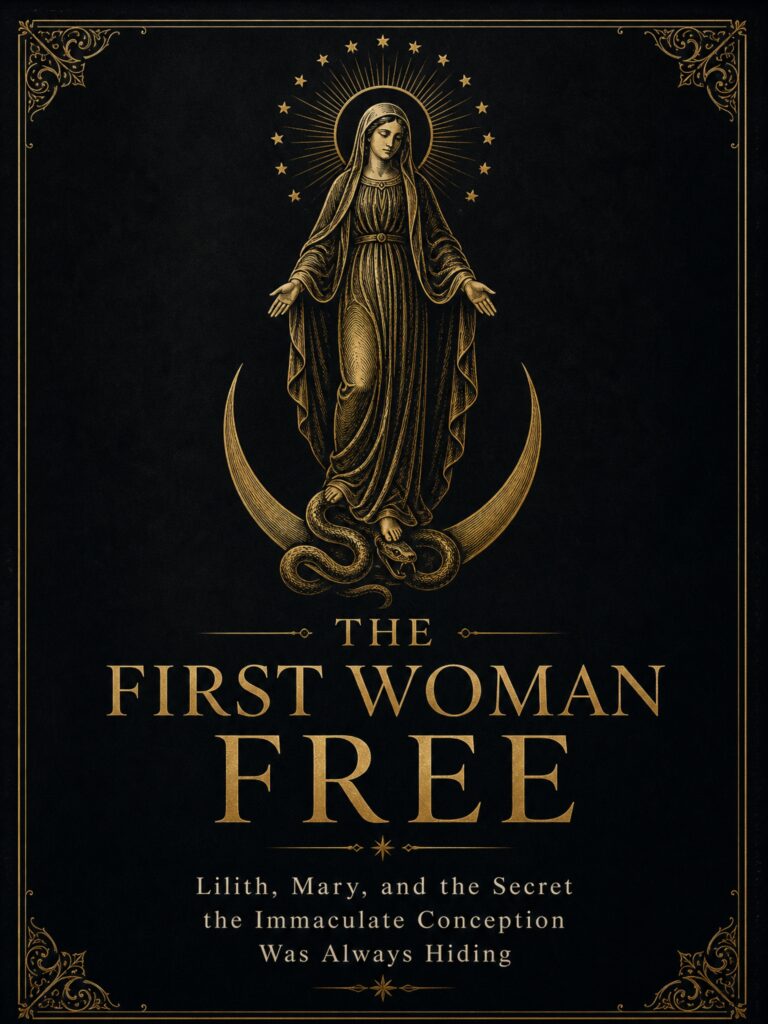
It means the most feared woman in the tradition’s demonological imagination was, in the tradition’s own terms, its most theologically anomalous figure. Not a sinner. Not a demon. Not a rebel against God. A human soul in possession of the original uncorrupted human nature, carrying it forward through time, toward a use the tradition would eventually need but could never acknowledge.
The full argument — how that soul returned, where it went, and what the tradition’s own doctrine of the Immaculate Conception confesses about it — is what The First Woman Free is built to make.
👉 Read The First Woman Free on Kindle: https://a.co/d/00DRA7bh